
BOP Releases Linked to Beaufort
The Federal Bureau of Prisons operates a national prison system. The research found no BOP institution in Beaufort County. A federal defendant arrested or prosecuted in the area may be housed far from Beaufort and may pass through local, U.S. Marshals Service, and BOP custody. Location must come from the actual federal record, not the county connection.
A BOP Locator result with a past release date, “RELEASED” or “Not in BOP Custody,” and no current facility supports departure from BOP on that date. It does not prove that every form of custody ended. State authorities, a local jail, ICE, or another agency may receive the person. Federal supervised release may also follow, though the public BOP result does not decide that status.
| Result or event | What it means | What remains open |
|---|---|---|
| Named BOP facility | The record reflects current federal prison location | Projected dates can change |
| RELEASED | BOP custody ended on the shown date | Later custody or supervision |
| Not in BOP Custody | No current BOP facility is assigned | Other agencies may have custody |
| IN TRANSIT | Federal movement is underway | It is not community release |
Confirm a BOP Release
The official BOP Inmate Locator accepts a BOP Register Number, DCDC number, FBI number, or INS number. It also supports name searching with age, race, and sex filters. Use the BOP number when known because it is less prone to a same-name error.
- Open the BOP Locator and choose number or name search.
- Enter the most reliable identifier. If using a name, add only known filters.
- Compare the register number and identity fields before accepting the match.
- Read the location and Release Date together. A past date with no facility supports BOP departure.
- Check any known state, local, immigration, or federal court process before describing community release.
The BOP locator-record explanation gives context for federal results.
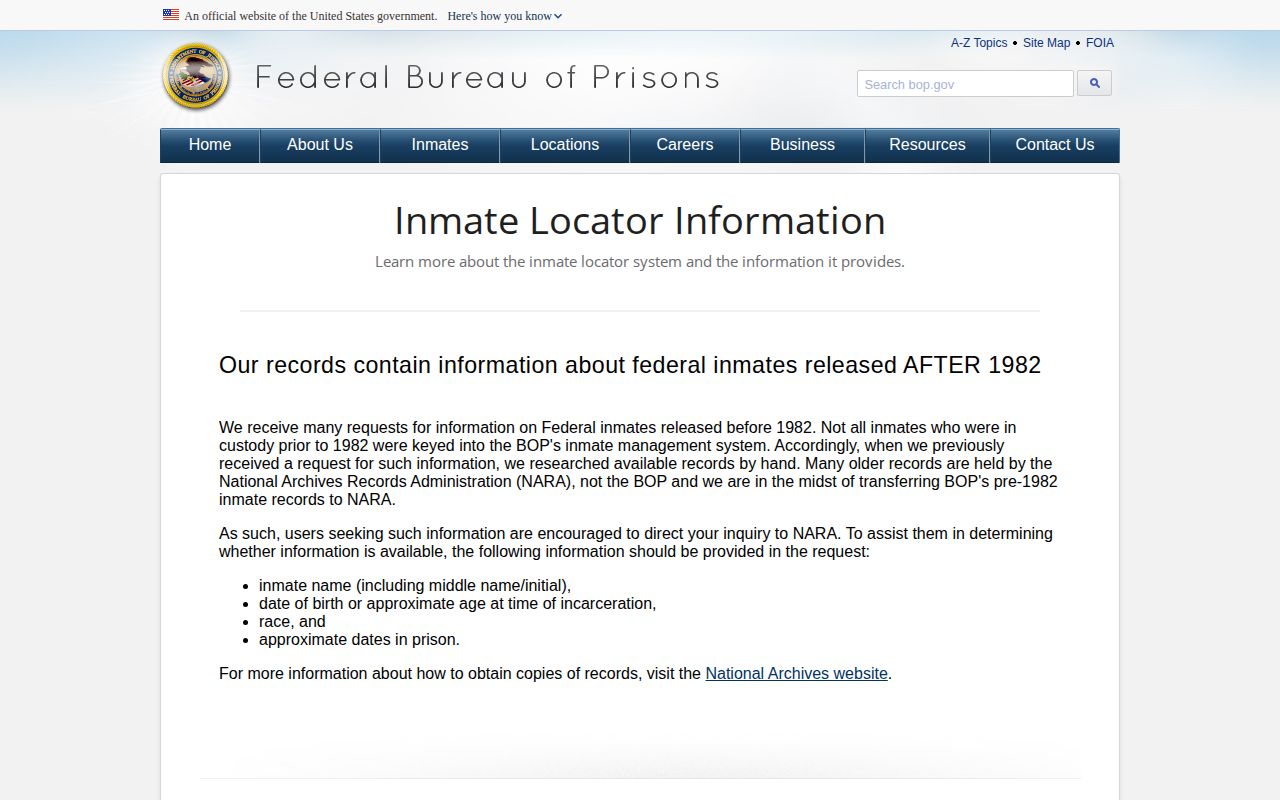
The official explanation helps distinguish a historical release field from a present institution. A Beaufort County jail release timestamp should never be substituted for the separate federal record.
Federal Release Record Fields
The BOP result can show name, register number, age, race, sex, release date, and location. Those fields are enough to identify the federal prison record and its current or historical status. They do not reproduce a federal court docket, a probation file, or the movement history between every custodian.
| BOP field | Record use |
|---|---|
| Register Number | Stable identifier for the BOP record |
| Name and age | Identity comparison, not sufficient alone |
| Location | Current institution or released status |
| Release Date | Past actual release or a future projected date |
| RELEASED wording | Departure from BOP, not all custody |
BOP Locator data generally covers federal records from 1982 forward. Older federal prison files may require the National Archives. A no-result can reflect the date range, spelling, identifiers, or the fact that the person never entered BOP custody.
A BOP release confirms departure from federal prison custody only. Check another custodian when the case facts support one.
BOP Historical Records Requests
Use the federal BOP Freedom of Information Act page when the locator lacks the required historical detail.
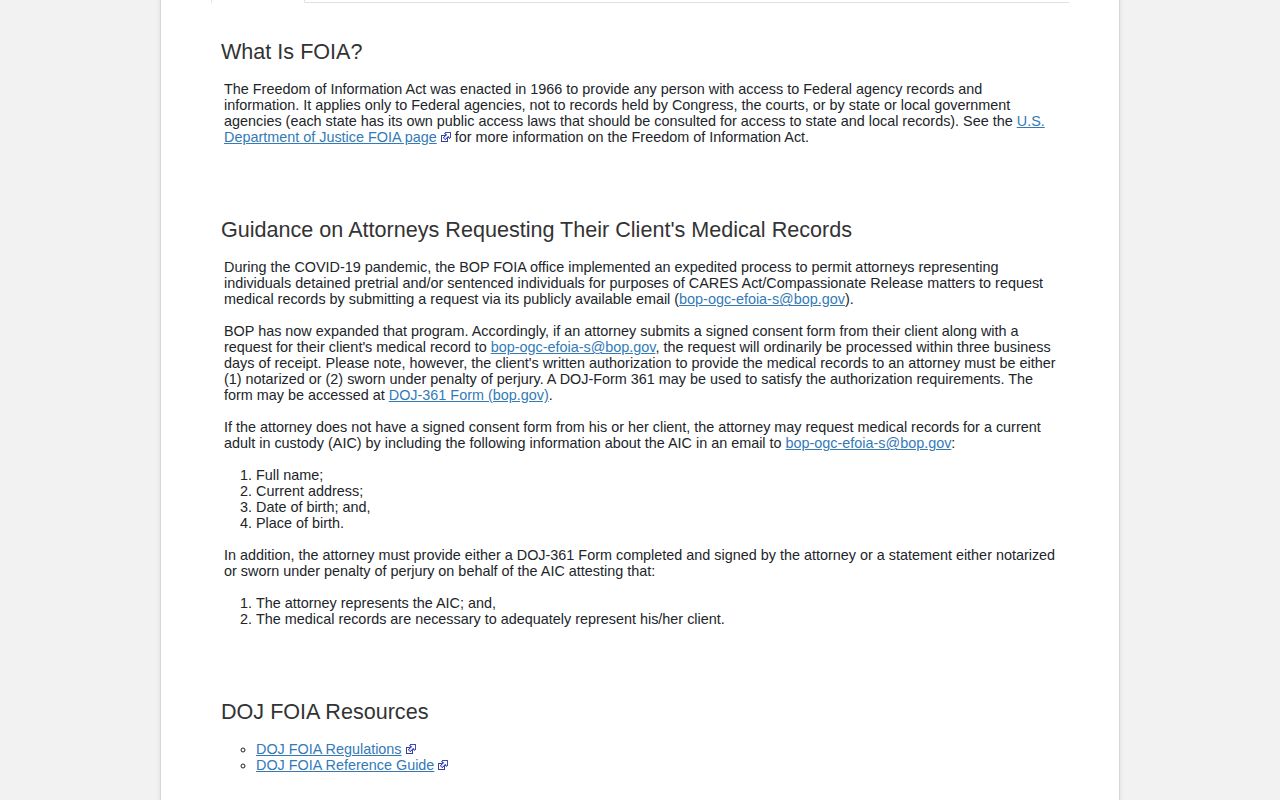
The captured BOP records page is the correct source for a federal prison file, while Beaufort County FOIA applies to county records. Keep requests separated by custodian.
A focused request should identify the person by full known name and BOP Register Number, give a bounded date range, and name the existing records sought. Useful targets can include the release or discharge record, recorded release date, release status, and movement or destination information if maintained and releasable. Do not ask BOP to create an explanation that is not already in an agency record.
Privacy and law-enforcement exemptions can limit what BOP supplies. Federal record rules differ from South Carolina FOIA timelines and county fee schedules. The source agency decides what can be released, and a public locator entry does not waive every protection in the underlying file.
Projected Federal Release Dates
A future date in the BOP Locator is projected. It can change. BOP warns that sentence recalculations under the First Step Act may make displayed dates stale. Court action, credit calculation, disciplinary outcomes, and other federal processing can also affect the date shown for a current prisoner.
Use precise language. “Projected release date” describes the planned date in the current BOP data. “Released” describes a past departure reflected by the record. Neither phrase should be expanded to “free from all custody” unless the relevant other systems have also been checked.
The projected release date resource explains why estimates and actual exits differ across custody systems. South Carolina sentence-credit law governs SCDC calculations, not BOP terms. Federal calculations must be confirmed through BOP and the federal case record rather than through the Beaufort jail or SCDC calculator.
USMS Before BOP Custody
The U.S. Marshals Service generally handles federal pretrial detention and prisoner transportation. A person can be in federal custody without yet having a normal BOP prison record or assigned institution. USMS may house a federal detainee in a contract or local setting and move the person after court proceedings.
There is no public USMS historical release locator comparable to the BOP tool. If BOP shows “IN TRANSIT,” a Marshals or court process may be involved. That wording must not be treated as a release into the community. The separate U.S. Marshals custody page covers the direct inquiry and FOIA route.
- Pretrial detention
- Custody before the federal case reaches final judgment.
- In transit
- Movement within a custody process, not release.
- Supervised release
- Court-ordered federal supervision after imprisonment.
- Detainer
- A hold or request that may cause a handoff to another agency.
An arrest notice or old booking image is not a current custody record. Use the court, USMS, and BOP sources for their distinct stages.
Beaufort and Federal Custody
A person may leave Beaufort County Detention Center because federal authorities took custody. The county's 15-day released feed can establish when the local episode ended, but it does not consistently name the release reason or destination. Request the county movement record when the receiving custodian matters.
If the person later enters BOP, the BOP number and location become the best current federal prison identifiers. A federal court docket supplies legal events and sentence context. It may explain an order but does not necessarily record the exact physical exit from every jail or transport hold.
The Beaufort County released inmate search keeps these systems separate. A local booking number, BOP Register Number, court case number, and dates should be preserved as distinct identifiers. Never merge two custody histories merely because names match.
After a Federal Prison Release
A person leaving BOP may begin federal supervised release under a court judgment. BOP Locator does not provide a full supervision record. The federal court and responsible probation office are the proper sources for the judgment and current reporting requirements. South Carolina's SCDPPPS system covers state supervision, not federal supervision.
An immigration transfer is another possible next step in some cases. ICE's locator can include certain people currently detained and some released within the past sixty days. A BOP departure plus an ICE result can document two stages, but a missing ICE result is not proof of freedom. ICE exclusions, timing, and suppressed records limit that inference.
A careful confirmation therefore answers a narrow question: did BOP custody end on the displayed date? The BOP locator or release record can answer that. Separate checks are needed for supervised release, USMS transport, ICE custody, or a state or local hold.