
Beaufort County VINELink Coverage
SC VINE is a free notification service fed by participating detention and supervision systems. Beaufort County links VINE from its own Detention Center site. State coverage includes participating county detention centers, two prison work camps, two city jails, SCDC, and SCDPPPS. The service is available online, through an app, and by telephone at 1-866-727-2846.
Coverage does not make VINE the source record. For a recent Beaufort County jail exit, the county's 15-day released feed provides the stronger local timestamp. For an SCDC discharge, use the separate Released Inmate List. Federal BOP and ICE custody require their own locators. A transfer from one system can appear as release from that agency while custody continues elsewhere.
Search Beaufort County VINELink Records
Open the South Carolina VINELink portal and identify the person before relying on a status. A shared name is not enough. Use an offender number when known, or add a middle initial and date of birth when the interface offers those fields.
- Choose South Carolina as the reporting state.
- Enter the adult's name or offender number.
- Compare identifiers and the reporting agency across all plausible matches.
- Open only the matching record and read the custody status and location.
- Confirm a release or transfer with the Beaufort County feed, SCDC released list, court record, or agency call.
The official portal image shows the South Carolina search route. Open the live VINELink source to perform a current check.
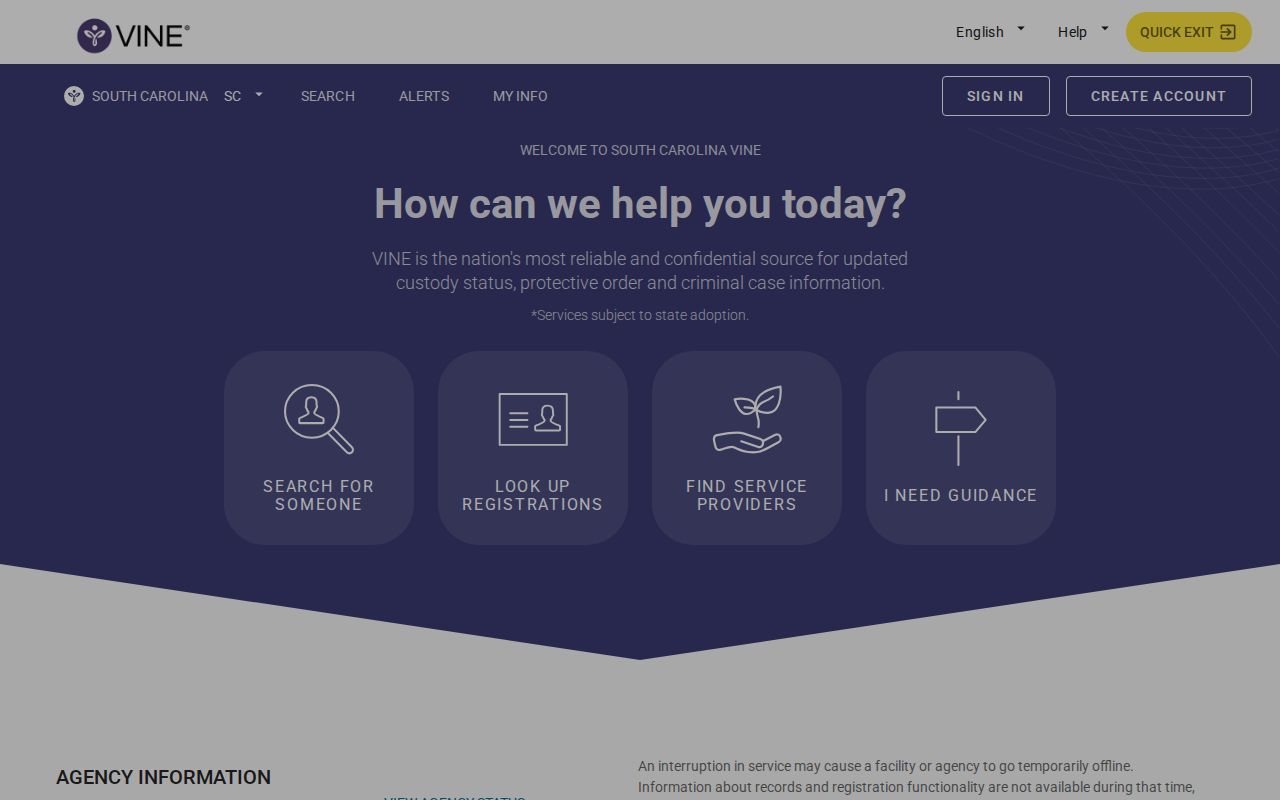
A current interface result is a lead tied to the reporting agency and observation time, not a permanent Beaufort County release certificate.
Beaufort VINELink Release Fields
VINELink may show enough detail to distinguish a custody record and trigger a prompt follow-up. Fields vary by source agency. Read every date by its label. A projected date is not an actual exit, and “no custody” does not explain whether a transfer, bond, or final discharge occurred.
| Field | What it supports |
|---|---|
| Name or offender number | Identity comparison with another official record |
| Custody status | The participating agency's reported state |
| Facility or location | The source custodian or last reported location |
| Release or custody-change notice | A prompt to verify the event with the custodian |
The Beaufort jail's public release feed can establish the exact local exit time within its 15-day window. SCDC removes released people from its current inmate search, so a state-prison release belongs in SCDC's released list. The Beaufort County released inmate search lays out those source differences.
Register Beaufort County Release Alerts
Registration must attach to the matching active record. The public may choose telephone, text, TTY, or email delivery in English or Spanish. Telephone registration uses a four-digit PIN. Keep that PIN because entering it acknowledges the alert and stops repeat calls.
- Open the verified active record and select notification or registration.
- Choose telephone, email, or an SMS-capable mobile number.
- Create and retain the four-digit PIN for telephone notices.
- Enter the PIN when an automated call arrives; otherwise calls may continue for 48 hours.
- Update contact details and register again after a transfer when the old registration does not follow.
Beaufort County's own instructions confirm local participation and telephone registration. Review the county VINE instructions before relying on an alert setup.
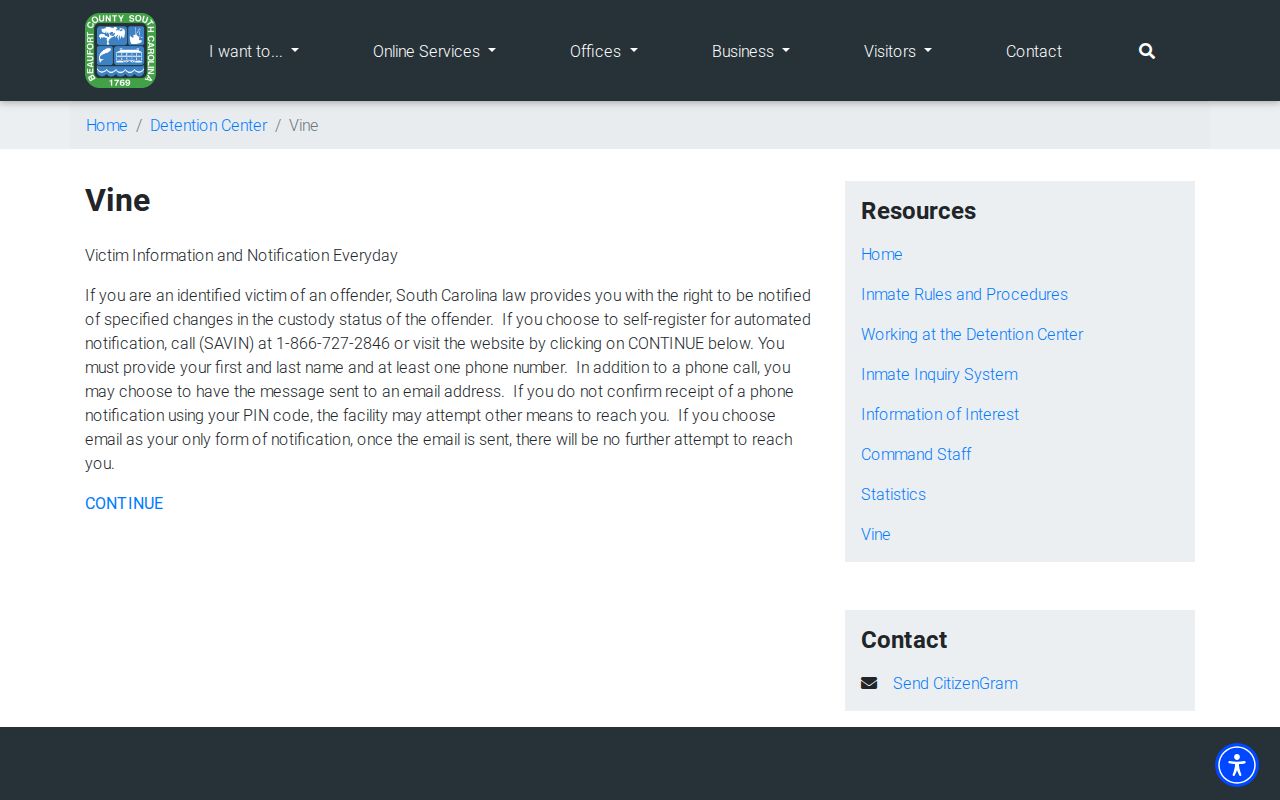
The county page also explains that an email-only notice receives no further attempt after transmission, so contact details must be accurate.
Beaufort VINELink Release Limits
SC VINE says participating data is collected every fifteen minutes, not instantly. It does not track adults out on bond. Juvenile and mental-health facilities are not displayed, and transfer can break registration continuity. An empty search can result from spelling, an excluded population, a source delay, suppression, or transfer.
Important: Never treat a blank VINELink result as proof of community release. Confirm with the actual county, state, federal, or immigration custodian.
BOP has its own locator for federal inmates. ICE uses its Online Detainee Locator, and USMS has no comparable public historical release search. A Beaufort County jail departure may also be a transfer. Ask the Detention Center for the release or movement record when destination matters.
Beaufort Release Alerts and Bond
SC VINE's frequent collection can make it useful for prompt notice, but adults out on bond are not tracked. That local limit is vital because bond is a common path out of the Beaufort County Detention Center. The county's released feed is the better public record of the local timestamp, while the court file explains the bond event.
Registrations may need to be recreated after transfer. Preserve the alert time and reporting agency, acknowledge a telephone call with the PIN, and then verify the event. For formal SCDC victim release notice, contact SCDC Victim Services at 1-800-835-0304. Parole-hearing notice is handled through SCDPPPS at 1-888-551-4118.
Note: Notification reports a change quickly, while a release or movement record supplies the more durable proof of what happened.
Confirm Beaufort VINELink Notices
A VINE alert should begin an evidence check. For Beaufort County Detention Center, compare it with the official 15-day released feed. That feed carries a generation timestamp and exact release time. It confirms departure from county custody, though it may not label the reason or destination.
For SCDC, use the current search while the person remains confined and the Released Inmate List after discharge. Selecting Beaufort links the state case to Beaufort as committing county. It does not prove physical release in Beaufort.
Federal and immigration systems are separate. BOP and ICE have their own locators, while USMS lacks a comparable public historical locator.
Beaufort VINELink No-Result Checks
Retry with an offender number or name variation. Identify whether the person belonged to the county jail, SCDC, BOP, ICE, or another custodian. Then check that source and request a movement record when the public window has passed.
Roster disappearance is not release proof. The person may have transferred, the feed may lag, the event may be old, or a lawful removal may have occurred. VINE says an adult with no custody information may be assumed released. Preserve “assumed,” because exclusion, suppression, transfer, and delay remain possible.
South Carolina Formal Release Notice
VINELink registration differs from formal SCDC victim notification. Registered victims, witnesses, or qualifying family members may receive temporary, provisional, final-release, or escape notice through SCDC Victim Services. The agency verifies registration outside the public web form.
Parole-hearing notice belongs to SCDPPPS. One web registration does not cover every hearing, transfer, and release.
Beaufort County VINE Instructions
Beaufort County publishes its own VINE information through the Detention Center. The local instructions name Victim Information and Notification Everyday and provide 1-866-727-2846. Registration uses the person's first and last name plus at least one telephone number, with email as another channel. That page establishes local participation more directly than a general description of the national service.
A telephone notice must be acknowledged with the PIN. Without that acknowledgment, automated calls may continue. An email-only notice receives no further attempt after transmission. Accurate contact information is vital, and these delivery rules can explain why an alert fails to reach a registrant even though the source agency reported an event.
The county instructions and statewide FAQ serve different roles. Beaufort confirms the local route. State material explains coverage, collection timing, bond exclusions, languages, and registration behavior. Use both when troubleshooting a missed notice.
Build a Beaufort Release Record Chain
Preserve the VINE alert time, named agency, custody label, and identifier. Then find the underlying official record. For a county episode, record the booking number and release timestamp from the 15-day feed. For state custody, use the SCDC ID, actual release date, release type, and committing county from the Released Inmate List.
Court records can explain a bond, dismissal, or sentence, but they may not establish the precise time a person walked out. Likewise, SCDPPPS can establish supervision after release without proving the prison gate time. Each source answers one part of the chain.
If sources conflict, note the time each was observed. Data can update on different schedules. The actual custodian's movement or discharge record is stronger than a stale alert. A narrow records request should identify the person, custody episode, approximate dates, and the release or transfer fields needed.
Avoid Beaufort VINELink Name Errors
Same-name results require more than a visual guess. Compare the middle initial, birth date when lawfully available, offender number, reporting agency, and location. Do not copy a full birth date or home address into public notes. Retain only enough information to show why the match is sound.
South Carolina and North Carolina both have a Beaufort County. South Carolina local government uses beaufortcountysc.gov, the sheriff uses bcso.net, and local telephone numbers use the 843 area code. An app or jail page tied to Washington, North Carolina, a 252 number, or beaufortcountysheriff.org belongs to the other jurisdiction and must not be used for this Beaufort County VINELink check.
Time Beaufort VINELink Checks
SC VINE collects data from participating source systems every fifteen minutes, but that interval is not a promise that each custody event appears within fifteen minutes. The source agency must first record and transmit the change. Preserve the time of the alert and the later confirmation so any lag remains clear.
A recent county release should be matched to the Beaufort feed's own generation time and release timestamp. If the feed is temporarily unavailable, call the Detention Center. Do not describe a short access failure as permanent closure, and do not turn a delayed alert into proof that the person remained in custody.