
ICE Releases After Beaufort Custody
An ICE detainer can create a misleading release entry. Beaufort County may record the end of its jail episode even when federal immigration custody begins next. A detainer is a request or hold associated with another authority. It does not prove that ICE actually took custody, and the county research found no published ICE contract, 287(g) page, or local detainer-release policy.
Use the Beaufort County movement or release record to learn whether a receiving agency was recorded. Then use ICE's own channels. The county's 15-day feed supplies an exit timestamp but does not consistently label the release reason. Roster disappearance alone proves even less.
| Evidence | What it supports | Limit |
|---|---|---|
| County release timestamp | Beaufort jail custody ended | Does not prove destination |
| Recorded ICE transfer | Named federal handoff | Confirm current status with ICE |
| ODLS current result | ICE custody and location information | Updates or disclosure may be limited |
| ODLS recent-release result | Recent departure reflected by ICE | Coverage is time-limited |
Search ICE Detainee Records
The Online Detainee Locator System, or ODLS, can include people currently in ICE custody and some who were released within the past sixty days. Search by the exact A-number plus country of birth, or by exact full name, date of birth, and country of birth. An A-number must be padded with leading zeros to nine digits.
- Choose the A-number route when the exact number is known.
- Enter all nine digits and the correct country of birth.
- Otherwise, enter the exact full name, birth date, and country of birth.
- Read the result as an ICE record, not as proof of a Beaufort jail event.
- For no result or urgent uncertainty, use ICE's direct information channels and request the county movement record.
The official ICE detention resource explanation describes locator scope and related resources.
The federal resource reinforces that ICE detention status must be checked in its own system. It cannot be inferred from a county roster.
ICE No-Result Release Limits
ODLS excludes people under eighteen. ICE can withhold a record for safety or discretion, and uploads may lag. Exact-name spelling, country-of-birth data, or an incomplete A-number can also prevent a match. Some released people remain searchable only within the recent sixty-day window.
A no-result must not be translated into “released.” It may mean the person is outside the locator's scope, the record has not updated, the identifying data differs, or disclosure is restricted. The most reliable next step depends on the known custody chain.
No ICE locator result is not proof of community release. Confirm the county handoff and ask ICE when facts support immigration custody.
- A-number
- An immigration identifier used by ICE, padded to nine digits for ODLS.
- Detainer
- A request or hold that may lead to a custody transfer.
- Transfer
- A change in custodian, not a release into the community.
- Non-detained case
- An immigration process managed outside detention, often through check-ins.
ICE Contact and Confirmation
When the locator cannot answer a time-sensitive question, use the ICE Detention Reporting and Information Line or the appropriate Enforcement and Removal Operations channel. Supply the exact known identity and A-number. Ask a narrow status question and note the date and agency of the response.
The Charleston check-in office at 3950 Faber Place Drive, North Charleston, SC, serves South Carolina. The research lists 843-746-9800 and Monday through Thursday hours of 8:30 a.m. to 3:30 p.m. Verify current hours before travel. A scheduled check-in is evidence of a non-detained immigration process, not proof of release from ICE or Beaufort County Detention Center.
3950 Faber Place Drive
North Charleston, SC
843-746-9800
Monday-Thursday, 8:30 a.m.-3:30 p.m.
ICE's official check-in contact page is the source for current office details. It should be used for navigation only when a person has a non-detained reporting matter.
ICE Check-Ins After Release
The federal ICE check-in guide explains appointments for people whose cases proceed outside detention.
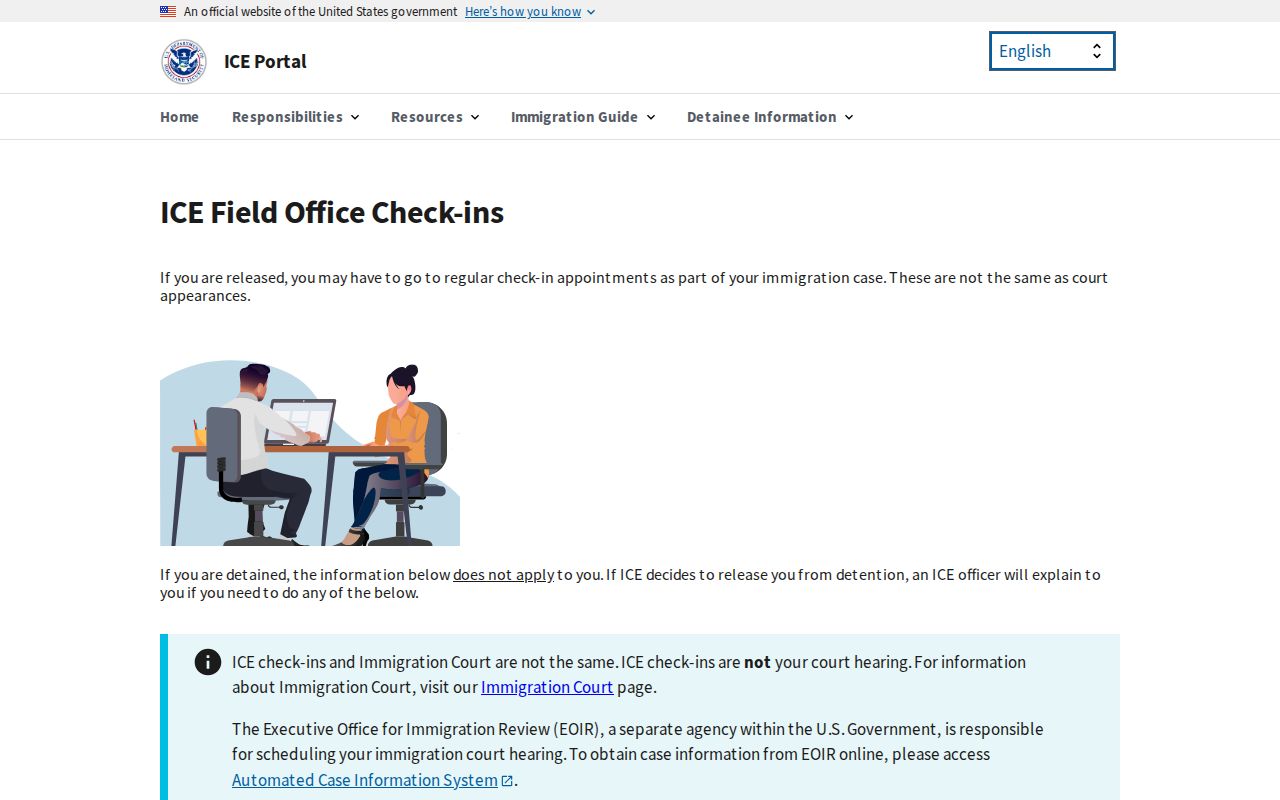
The check-in resource describes what follows a non-detained placement. It does not certify when the person left ICE custody or the Beaufort County jail.
Keep the sequence clear. A county record may show release to another agency. ODLS may then show ICE detention. A later check-in direction may show that the immigration matter continues outside detention. Each is a different event with a different source.
For personal planning, confirm appointment instructions through ICE. Do not infer an office appointment from an old locator result. The person's current federal notice controls the place, time, and reporting terms.
Request ICE Release Records
When a historical ICE release or transfer detail is not public in ODLS, use the agency's records process. A focused request should identify the person and A-number, provide a bounded date range, and name the existing custody or release record sought. Ask for the recorded ICE custody dates, release status, and transfer or destination information if maintained and releasable.
Federal privacy and law-enforcement rules can restrict disclosure. A requester should not expect ODLS to expose the full immigration file. Separate the county request from the federal request: Beaufort County controls its jail movement record, while ICE controls its detention record.
The Beaufort County released inmate search explains the county record route. Use the local booking number for the county request and the A-number for the ICE request. Those identifiers should not be merged merely because the names appear alike.
Beaufort Jail and ICE Records
Begin with the official county inquiry gateway when a local booking is known. The fifteen-day released view can establish the date and time Beaufort custody ended. If the entry has aged out or the release reason is unclear, contact the Detention Center at 843-255-5200 or use Beaufort County's FOIA portal for the existing booking/release sheet and movement record.
Ask specifically for destination or receiving agency if recorded. Do not ask the county to determine an immigration status or create a legal explanation it does not maintain. If the movement record names ICE, carry that fact into the federal inquiry. If it does not, do not label the departure an ICE transfer based on rumor or roster absence.
Court events can explain a local bond or case outcome, but they do not establish an ICE handoff. VINE may provide a prompt notification, yet the custodian's record remains the more durable historical source.
ICE Release Evidence Chain
An accurate chain records identity, the source agency, the custody episode, the observation date, and whether the displayed field is current or historical. First document the Beaufort exit. Next document any transfer. Then read the ICE result on its own terms.
If sources conflict, preserve both dates and ask the custodian. A lagging ODLS entry should not erase a newer agency response. Likewise, an empty locator result should not override a county movement record naming federal pickup.
ICE detention is civil federal custody, not SCDC imprisonment and not U.S. Marshals pretrial custody. The BOP Locator will not answer an ICE detainee question. Keeping each federal channel in its proper role prevents a release from one system from being mistaken for freedom from all systems.